Lifestyle center retail: what makes an open-air center a destination
By Tully Zeitlin · Published
Lifestyle center retail is the open-air format built around specialty stores, restaurants and a main street or a green, and what makes one a destination is what happens on that main street after the stores close. A lifestyle center with a calendar is somewhere people go on a Thursday; a lifestyle center without one is a nicer place to park. This page covers what a lifestyle center is, how the format is holding up in the traffic data, and what turns one into the place people spend the day. The owner's case for experiences across a whole center is in our guide to experiential retail.
What is a lifestyle center
The industry's trade body, ICSC, classifies a lifestyle center as a specialized open-air center with "upscale national-chain specialty stores with dining and entertainment in an outdoor setting," as quoted in a 2015 essay on the format in The Conversation. Source: The Conversation, March 2015. A 2005 review of ICSC's U.S. classification scheme from the Runstad Center at the University of Washington lists the lifestyle center among the open-air types at roughly 150,000 to 500,000 square feet, with upscale national specialty retail, entertainment and an outdoor layout as the concept, and notes that the scheme is revisited as new formats appear. Source: DeLisle, "U.S. Shopping Center Classifications," Research Review 2005.
In plain terms: a lifestyle center is the open-air alternative to the enclosed mall. It usually has no department store, it has restaurants with patios where the anchor would have been, and it is laid out as a street or a square rather than a corridor. The same essay describes the format as a revival of the Main Street the enclosed mall replaced, and asks whether that is a community or a facade. The answer depends on the calendar.
The different types of shopping centers
The ICSC scheme reproduced in the 2005 review divides U.S. centers into two families. Malls are enclosed: the regional center, anchored by general merchandise and fashion, and the larger super-regional center with more of the same. Open-air centers are the rest: the neighborhood center built on convenience, the community center on general merchandise and convenience, the lifestyle center on upscale specialty retail and entertainment, the power center on a few category-dominant anchors, the theme or festival center on leisure and tourism, and the outlet center on manufacturers' stores. Mixed-use districts, where retail is the ground floor of homes and offices, sit outside the scheme and borrow most from the lifestyle center.
Why open-air lifestyle center retail holds its traffic
Placer.ai's Mall Index tracks visits to 100 top-tier indoor malls, 100 open-air shopping centers and 100 outlet malls. Two reads from it:
Open-air shopping centers were the only format whose visits consistently met or exceeded pre-pandemic levels over the two years to mid-2025, with second-quarter 2025 visits 2.7 percent above the second quarter of 2019. Source: Placer.ai, June 2025 Mall Index, published July 7, 2025.
Over the 2025 holidays, open-air centers led the formats, with fourth-quarter visits up 2.0 percent year over year and December up 1.5 percent. Placer.ai credits sit-down, alcohol-forward dining and layouts that make a quick trip easy. Source: Placer.ai, December 2025 Mall Index, published January 7, 2026.
The restaurants are the reason. An open-air lifestyle center with sit-down dining has the one thing an online order cannot replace, a table outside on a good evening, and the traffic data shows people choosing it. Where the enclosed mall goes from here is on our page about the future of shopping centers.
What makes a lifestyle center a destination
The format gives a center the stage. The calendar is what puts something on it. Every calendar we build stands on one architecture: a weekly rhythm people can count on, monthly anchors that spike traffic, and seasonal tentpoles that put a place on the map, drawn from a working catalog of 150-plus formats across twelve categories, tuned to each property, its tenants, and its seasons.
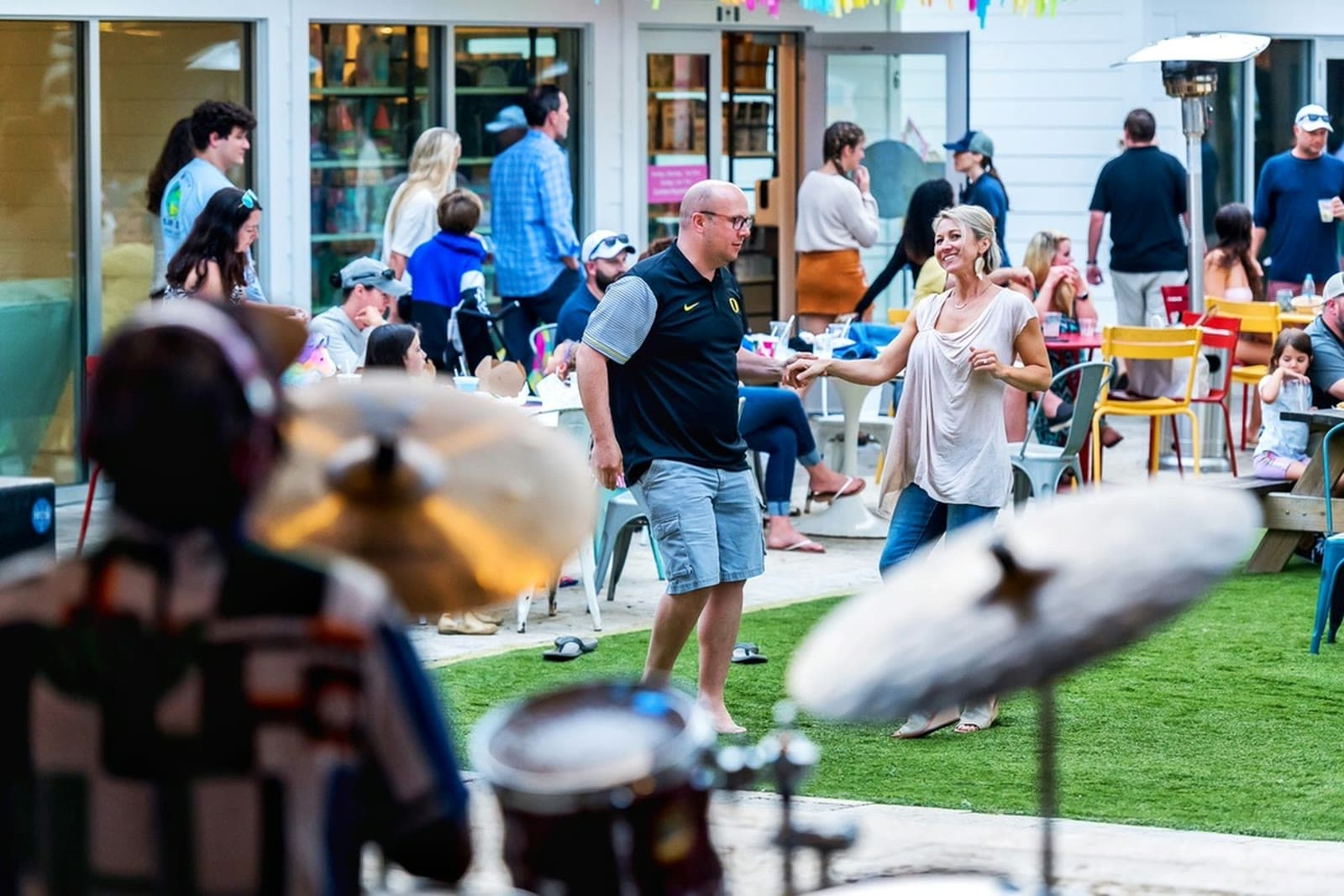
At a lifestyle center that means the main street and the green become the stage, and the tenants are paired into every moment: a featured pour or bite, sidewalk sales beside the makers market, a themed menu on the watch-party night. The calendar favors smaller events, more often, through the week, over one big night, so the traffic reaches the tenants on more of the nights they are open. The weekly rhythm does the heavy lifting: an acoustic set on the patios as the day cools, a trivia or game night built with a restaurant tenant, a family evening with a movie and a character moment, a market morning for local makers. Each one is small, inexpensive, and placed on the nights the tenants need it most. The full list of ideas, and how to tell which worked, is on shopping center marketing ideas.
Visits that become habits: the same good night every week, and a reason to come back on the others. That is what separates a lifestyle center that is a destination from one that is a nicer place to park, and it is the question The Conversation's essay was asking. A center people come to without a shopping list is a third place, and a third place is worth more to its tenants than a thoroughfare.
Lifestyle center retail on the owner's ledger
For a retail center the measures are traffic, dwell and tenant sales per square foot, and differentiation when every center is fighting for the same consumer. At our own venues the measures were traffic and sales: orders and receipts on programmed days against the days without. The same measures work at your center, on the numbers you already run it on: tenant sales, traffic, and the growth of your audience on email, text, and social.
Who runs the calendar at a lifestyle center
Tenants run their own in-store experiences. The common area is the owner's, and on most centers nobody has that job. We plan, book, and produce; the vendor network, the talent, the sponsors and the schedule are built and running today, as an operating team behind yours. Our page for retail and lifestyle centers describes how that engagement works at a center.
Frequently asked questions
What is a lifestyle center?
An open-air shopping center built around upscale specialty stores, restaurants and entertainment, laid out as a main street or a square rather than an enclosed corridor, usually without a department-store anchor. ICSC's classification puts it among the open-air center types at roughly 150,000 to 500,000 square feet.
What are the different types of shopping centers?
Under the ICSC scheme, two families. Enclosed malls: regional and super-regional centers. Open-air centers: neighborhood, community, lifestyle, power, theme or festival, and outlet centers, each defined by its concept and size.
What is an open-air lifestyle center?
The same thing; every lifestyle center is open-air by definition. The phrase is used to set the format apart from the enclosed mall it replaced, and from open-air power centers built around big-box anchors.
How is a lifestyle center different from a mall?
A mall is enclosed and anchored by department stores. A lifestyle center is outdoors, usually unanchored, and built around specialty stores and restaurants on a street or a square. In 2025 traffic data, open-air centers held above their 2019 visit levels while top-tier indoor malls grew back toward theirs.
What makes a lifestyle center a destination?
A calendar: a weekly rhythm people can count on, monthly anchors and seasonal tentpoles, with the tenants paired into every moment so the traffic lands on their registers. The format supplies the stage. The programming supplies the reason to come.
Get in touch.
Tell us about the center. We listen first, propose what fits, and shape the engagement around what you actually need.