Placemaking: what it is, and what keeps a place alive after it opens
Placemaking is the practice of shaping a physical space so it becomes a place people choose, return to, and remember. It has two halves. One is the design of the space: the lawn, the plaza, the stage, the street. The other is the programming of it: what happens there, week after week, once it opens. Most definitions stop at the first half. This guide covers both, and spends most of its time on the second, because that is the half that decides whether the place stays alive.
Where the word placemaking comes from
The thinking behind placemaking goes back to the 1960s, when Jane Jacobs and William H. Whyte argued for designing cities around the people who use them. Project for Public Spaces, a nonprofit that has worked on public space since 1975, has used the word consistently since the mid-1990s for a collaborative process: listen to the people who use a space, build a shared vision, start with small improvements, and keep going. That is the public-space tradition, and it is a good one.
The real estate version of the word arrived later. Today almost every mixed-use project, lifestyle center and downtown plan is pitched as placemaking: the lawn, the stage, the string lights, the renderings full of people. The word now describes the intent of a project as much as a process. This guide takes the word at its intent and asks what it takes to deliver on it.
What a sense of place is
A sense of place is what a visitor feels when a location is somewhere rather than anywhere: they know where they are, they recognize the people, and they can picture coming back. Design gives a place its look. Habit gives it its sense: the same good night every week, the monthly event people put on the calendar, the season's big weekend. A sense of place is earned over time by what happens there, which is why it cannot be finished on opening day.
Placemaking design vs. placemaking programming
Placemaking design is the work that ends at the ribbon cutting: the master plan, the landscape, the stage, the lighting, the street furniture, the tenant mix. It is capital. It is drawn once, and it is mostly finished before the first visitor arrives.
Placemaking programming is the work that begins at the ribbon cutting and never ends: the weekly night people can count on, the monthly event that spikes traffic, the seasonal weekend that puts the place on the map. It is operating, not capital. It is planned a quarter ahead and run from a call sheet on the day.
A project needs both halves. A beautiful place with an empty calendar is a rendering you can walk through. The two halves also have different owners, which is the subject of the next two sections.
Placemaking vs. activation vs. amenity programming
Three words get used for the same thing, and they are not the same thing.
Activation, in the agency sense, is a moment: a brand pop-up, a launch weekend, a one-time festival. It can be excellent, and it ends. The day after, the place is what it was. At the other extreme, for many owners, activating the green space means cutting the grass once a month.
Amenity programming is the fitness class, the resident mixer, the tenant appreciation lunch. It is run for the people who are already there, usually by the property team, usually on a weekday. It keeps residents and tenants happy. It does not bring the town.
Placemaking programming is built for the public as well as the people on site. Its job is the draw: the reason someone who does not live or work there comes on a Thursday, stays for dinner, and comes back next Thursday. It needs a calendar, a vendor and talent network, sponsors, community partners, a run of show for every day, and someone whose job it is. That is the difference. Activation is an event. Amenity programming is a service to tenants. Placemaking programming is an operating discipline.
Who does placemaking
Before opening, placemaking belongs to designers: the planners, landscape architects and architects who shape the space, often through the public process Project for Public Spaces describes. Cities do it through their parks and downtown departments. Developers do it through the master plan and the tenant mix.
After opening, the question gets harder, and most projects never answer it. Everyone building today calls it placemaking. The lawn gets poured. The stage gets wired. The renderings are full of people. Then the ribbon is cut, and the calendar stays empty. That is not because owners stop caring. It is because nobody on the team has that job: property teams run the property, leasing leases, and there is no department for Saturday night.
The owner has four options for that job: build the department in house, give it to the property manager on top of the day job, hire an event producer one event at a time, or bring in a placemaking and event programming company that plans and runs the calendar as an operating partner. We are the fourth, and how event programming works and who we work with describe that in detail. The honest summary is that each option can work. What fails is leaving the question open.
What keeps a place alive after it opens
Programming is the first engine: it creates the draw. Community engagement is a second lever. Developing trusted relationships with corporations who bring us their annual traditions, charities who build their biggest nights with us, and schools, academies, and arts organizations whose recitals and showcases need a stage. Those events happen every year. The only question is where.
Every calendar we build stands on one architecture: a weekly rhythm people can count on, monthly anchors that spike traffic, and seasonal tentpoles that put a place on the map, drawn from a working catalog of 150-plus formats across twelve categories, tuned to each property, its tenants, and its seasons.
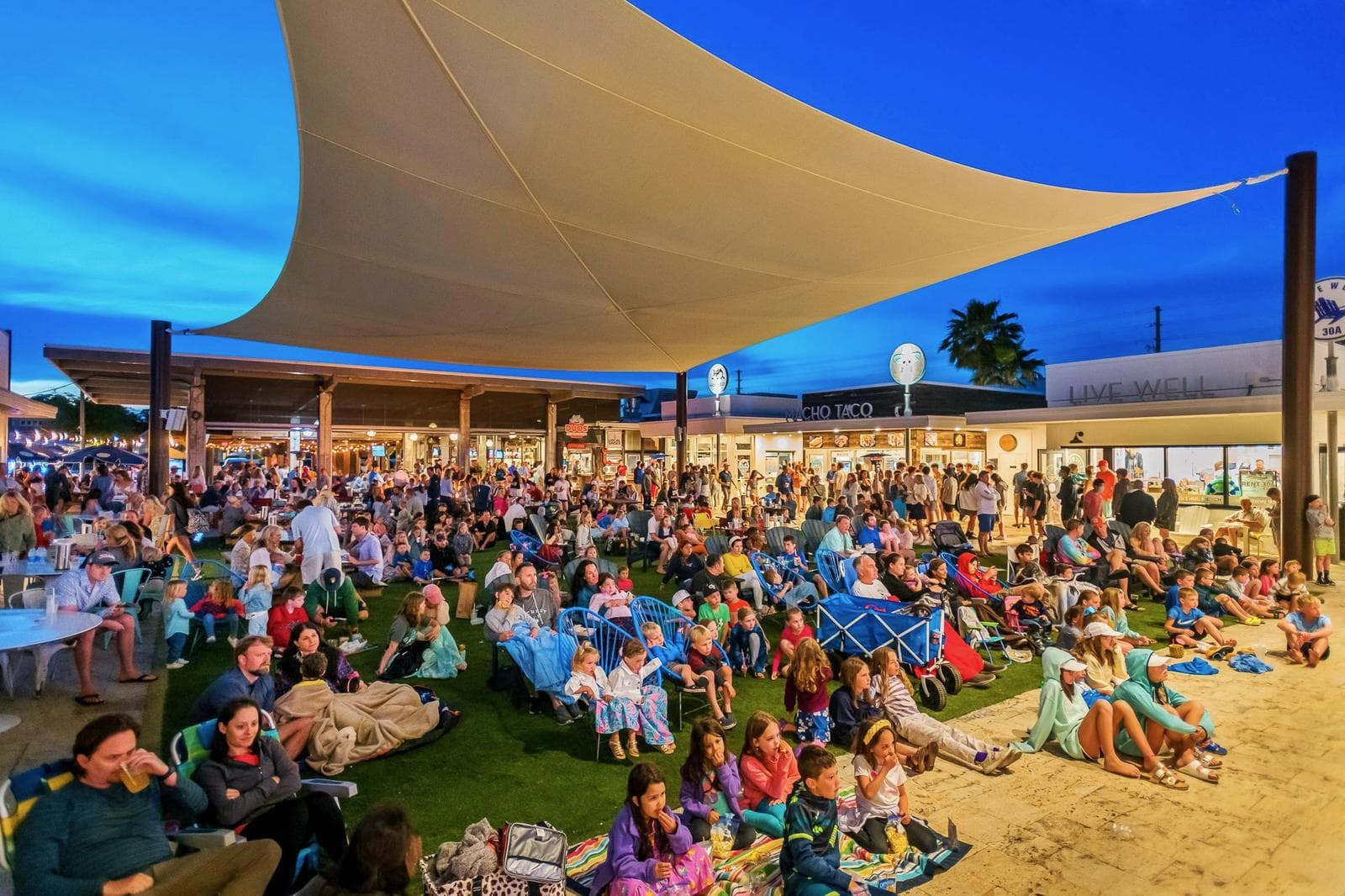
Food is programming too. A movie night is never just a movie: it is the movie, the food vendor, the kids' activity before dark, and the restaurant that stays full after.
The economics land on your P&L, not just a marketing line. Increased traffic. Longer dwell times. Higher sales per square foot. Stronger tenant retention. Higher rents. Faster leasing. Renewed community relevance. That is what the experience layer is for. Measured on the numbers you already run the property on: attendance, food and beverage, tenant sales, and the growth of your own list.
This is the work The HUB Experience Company does: year-round event programming for real estate owners and developers, planned, booked and run as an operating team behind yours. Mixed-use owners start here, and cities here. If the place you are building is meant to be a town's third place, or a center that sells more because people come for the day, we have written about experiential retail as well.
Frequently asked questions
What is placemaking?
Placemaking is the practice of shaping a physical space so it becomes a place people choose, return to, and remember. It covers the design of the space and the programming of what happens there once it opens.
What is the difference between placemaking and activation?
An activation is a moment: a pop-up, a launch weekend, a one-time event. Placemaking programming is the ongoing calendar that makes a place somewhere people go on an ordinary Thursday. One ends. The other is operated.
What is a sense of place?
The feeling that a location is somewhere rather than anywhere. Design starts it, and habit finishes it: the weekly night, the monthly event, the season's big weekend, repeated until people can picture coming back.
Who is responsible for placemaking after a project opens?
Whoever is given the job. On most projects nobody is, so the calendar stays empty. The options are an in-house department, the property manager, an event producer, or a placemaking and event programming company that runs the calendar as an operating partner.
How do you measure placemaking?
On the numbers the owner already runs the property on: visits, dwell time, food and beverage, tenant sales, leasing and renewals. At our own venues the measures were traffic and sales: orders and receipts on programmed days against the days without.
KEEP READING
- Measuring placemaking ROI
- Placemaking examples
- Placemaking for real estate developers
- Measuring placemaking results
- Placemaking vs event programming
- Effective placemaking strategies
- What a placemaking firm does
- Placemaking after opening
- The third place
- Experiential retail
- Mixed-use developments
- How event programming works
Get in touch.
Get in touch. We listen first, propose what fits, and shape the engagement around what you actually need.