Experiential retail for shopping center owners: the programming that brings people back
Experiential retail is retail that gives people a reason to visit beyond the purchase: something to do, see, taste or take part in, at the store or across the whole center. Most of what is written about it is about the store. This guide is written for the owner of the center, because the owner's ledger is where experiential retail shows up, and the common area is the part no tenant can run alone.
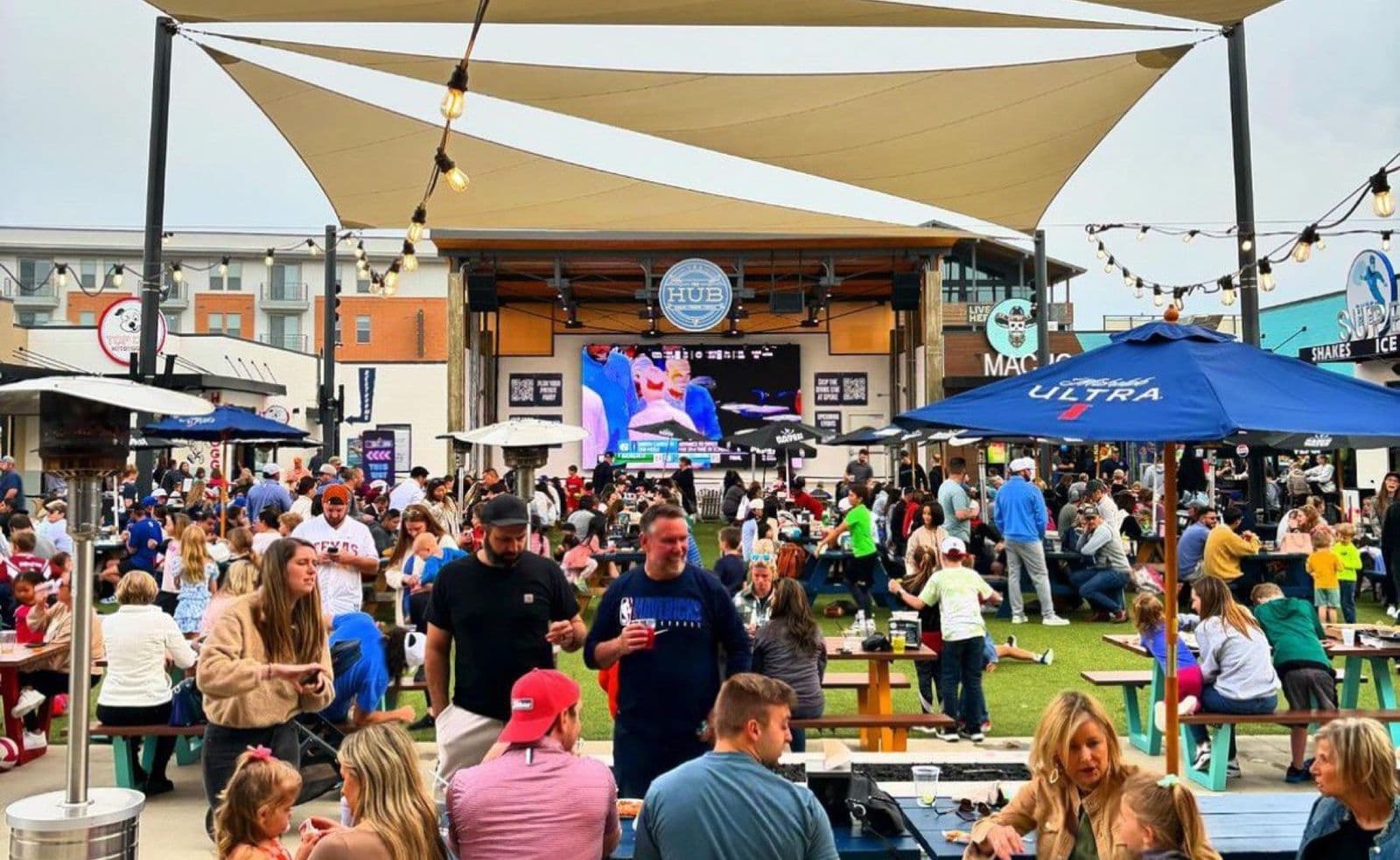
Why experiential retail matters on the owner's ledger
A store runs an experience to sell more in that store. An owner runs experiences across a center to change the numbers the whole property is valued on. The economics land on your P&L, not just a marketing line. Increased traffic. Longer dwell times. Higher sales per square foot. Stronger tenant retention. Higher rents. Faster leasing. Renewed community relevance. That is what the experience layer is for.
And memory is the last channel that still works: advertising fades, experiences stay, the repeat visit, the recommendation, the shared story. A center people come to on purpose, on an ordinary weeknight, is a center whose tenants renew.
Store-level vs. center-level experiential retail
Store-level experiential retail belongs to the tenant: the flagship's climbing wall, the demo kitchen, the in-store class, the fitting room with a stylist. It is real, it is well covered elsewhere, and it ends at the lease line.
Center-level experiential retail belongs to the owner: the plaza, the lawn, the street, the parking field on a Saturday morning, the stage that came with the project. This is the part of the center every tenant benefits from and no tenant can run. It is also the part that most often sits empty, because the leasing team leases, the property team runs the property, and nobody's job is Thursday night.
You create the place. We create reasons people want to be there. The rest of this guide is about the center level.
Experiential retail examples at center scale
Formats like these are what experiential retail looks like at center scale. Each is a reason to come that is not a purchase, and each is layered: a movie night is never just a movie.
A weekly night people can count on: live music on the plaza every Thursday, a farmers or makers market every Saturday morning, trivia at the same restaurant each week.
Monthly anchors that spike traffic: an outdoor movie night on the lawn, a watch party for the big game, a family afternoon with a theme, each one layered with the food, the vendors and the tenant offers that turn a crowd into sales.
Seasonal tentpoles that put the center on the map: a holiday lighting weekend, a spring festival, a summer concert series, the moments people drive in for and tell their friends about.
Tenant collaboration: the restaurant's chef on the plaza stage, the boutique's trunk show timed to the market, the fitness tenant's class on the lawn before the Saturday crowd arrives.
Community engagement: corporations who bring us their annual traditions, charities who build their biggest nights with us, and schools, academies, and arts organizations whose recitals and showcases need a stage. Those events happen every year. The only question is where.
Brand partnerships: the local bank's name on the summer series, the car dealer's display on movie night, the brand that pays to be in front of the center's own audience.
Food is programming too. A center with sit-down restaurants has an advantage here, and the traffic data below says so.
Experiential retail statistics, with sources
These are figures from named public sources, each linked. We cite only what we read ourselves.
Open-air shopping centers were the only mall format whose visits consistently met or exceeded pre-pandemic levels over the two years to mid-2025, and their second-quarter 2025 visits were 2.7 percent above the second quarter of 2019. Source: Placer.ai, June 2025 Mall Index, published July 7, 2025.
Over the 2025 holidays, open-air centers led the mall formats, with fourth-quarter visits up 2.0 percent year over year and December up 1.5 percent. Placer.ai credits sit-down, alcohol-forward dining and layouts that make a quick trip easy. Source: Placer.ai, December 2025 Mall Index, published January 7, 2026.
In a June 2026 survey of 1,004 U.S. parents with children aged 3 to 16, 86 percent said family-friendly experiences influence where they choose to shop, and 79 percent said regular family-oriented events or activities would make them more likely to visit a shopping center. Nearly three in five visit a center or retail district with their children at least weekly, and 81 percent of those go for discretionary reasons: dining, entertainment, children's activities or socializing. These are stated preferences, not observed behavior. Source: ICSC, "ICSC Research Finds Family-Friendly Experiences Influence Where Families Shop, Spend, and Gather", August 13, 2026.
Industry-reported figures put recall of an in-person experience at 65 to 80 percent after 30 days, against 10 to 25 percent for a digital ad, a three-to-eight-times difference. Source: Street Teams Co, experiential marketing statistics, 2026, a secondary source that does not disclose its underlying studies, which is why we label it industry-reported.
What it takes to run experiential retail every week
We plan, book, and produce. The vendor network, the talent, the sponsors, the schedule, built and running today. The part nobody wants to build in-house. We run execution on paper. A detailed call sheet for every event day, down to where the vendor sets up and when the water gets to the band. One line of communication. One calendar, one call sheet, one contact.
An operating team behind yours. You keep the brand, the voice, and the final say on every line of the calendar. We carry the work that makes the calendar real: planning, booking, vendor and talent management, the daily run of show, and the tenant follow-through. A department's output, without building the department.
Every calendar we build stands on one architecture: a weekly rhythm people can count on, monthly anchors that spike traffic, and seasonal tentpoles that put a place on the map, drawn from a working catalog of 150-plus formats across twelve categories, tuned to each property, its tenants, and its seasons. How an engagement starts, phase by phase, is on how event programming works. What we run, and for whom, is on event programming.
Experiential retail for retail and lifestyle centers
If you own or operate a retail or lifestyle center, start with our page for retail and lifestyle centers: more traffic, longer dwell, higher tenant sales per foot, and differentiation when every center fights for the same consumer. Mixed-use owners with a retail ground floor start here. If the question is bigger than the center, placemaking covers the design half and the programming half, and the third place covers why a center people come to without a shopping list is worth more.
Frequently asked questions
What is experiential retail?
Retail that gives people a reason to visit beyond the purchase: something to do, see, taste or take part in. At a store it is the class or the demo. At a center it is the calendar in the common area that brings people on a weeknight.
What are examples of experiential retail?
At store level, a climbing wall in a flagship, a demo kitchen, an in-store class. At center level, a weekly market, live music on the plaza, an outdoor movie night, a holiday lighting weekend, a chef on the stage, a school's recital, a charity's big night.
Does experiential retail increase sales?
At the center level it is measured on the numbers the owner already runs on: visits, dwell, tenant sales, leasing and renewals. At our own venues the measures were traffic and sales: orders and receipts on programmed days against the days without.
What is retailtainment?
An older word for the same idea, mostly used about malls and stores: entertainment built into the shopping trip. We say experiential retail for the center-level version, because an owner's calendar is bigger than entertainment.
Who runs experiential retail at a shopping center?
Tenants run their own. The common area is the owner's, and on most centers nobody has that job. The options are an in-house events team, the property manager, an event producer one event at a time, or a placemaking and event programming company that plans and runs the calendar with the owner's team.
Is experiential retail only for large centers?
No. One plaza, a lawn, or a street with four restaurants can carry a weekly rhythm. The rhythm matters more than the acreage.
KEEP READING
- Future of shopping centers
- Lifestyle centers
- Retailtainment
- Shopping center marketing ideas
- Events and tenant sales
- Event ideas for shopping centers
- Experiential retail for owners
- Increasing foot traffic
- Pop-up stores in malls
- Retail and lifestyle centers
- Mixed-use developments
- Placemaking
- The third place
- Event programming
Get in touch.
Get in touch. We listen first, propose what fits, and shape the engagement around what you actually need.